A Museum Visit Built Around One Motif
A museum visit built around one motif helps you compare artworks closely, notice changing meanings and leave with a clearer sense of what you saw.
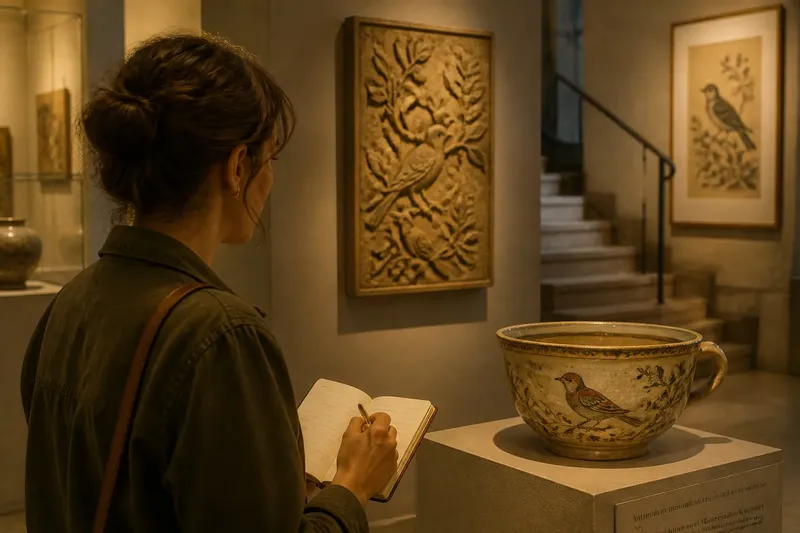
You stop before a painted bowl and notice a bird tucked beside its rim. Later, a bird appears on a carved panel, then in a print near the stairs. A museum visit built around one motif can turn those separate encounters into a conversation between works, without asking you to see every room.
Choose a motif you can recognise, then follow it at your own pace. A motif might be a plant, animal, repeated shape, gesture or object. The point is not to prove that every appearance means the same thing. It is to look closely at what changes when artists place a familiar form in different settings.
How do you choose a motif for a museum visit?
Begin with a form that catches your eye in the first room, or choose one before you arrive. A key, a hand, a star, a pair of birds or a spiral can be easier to track than an abstract idea such as power or grief. Look for something visible enough to recognise, but open enough to appear in varied forms.
A motif need not be an exact repeated image. A leaf might be painted realistically, reduced to a border pattern, or suggested by the shape of a textile. Decide what counts as a resemblance for your visit. A flexible definition lets you notice transformation; one that is too broad can make almost anything seem relevant.
If you choose in advance, check the museum’s collection pages or gallery map for likely starting points, but treat them as prompts rather than a route you must complete. If you choose on the spot, give yourself a moment to notice what draws your attention before reaching for a label or phone.
How can you make the first encounter useful?
At the first work, take in the whole object before concentrating on the motif. Notice its scale, materials, colours and setting. Then look at where the motif appears: at the centre, along an edge, repeated across a surface, or partly hidden. Its placement can shape your reading as much as its form.
Record a few observations in a pocket notebook or on your phone. Keep them concrete: “small red bird, beside the handle” is more useful than “bird means freedom”. The first note describes what you can inspect again; the second jumps to an interpretation that may or may not fit.
Read the gallery label after looking. It may identify a maker, material, use or original setting that changes what you notice. You do not need to accept every label as a final explanation. Let it add context, then return your eyes to the object and ask what the motif does within it.
What should you compare between works?
Comparison works best when you hold one question steady and let the objects answer differently. A motif is a little like the same word spoken in different rooms: its sound remains recognisable, but the surroundings alter its force. In a museum, those surroundings include material, scale, neighbouring images and the object’s purpose.
Try comparing these features:
- Placement: Does the motif command attention, decorate an edge or sit quietly in the background?
- Material: Is it painted, carved, woven, printed or shaped from metal?
- Repetition: Does it appear once, form a pattern or seem to answer another image?
- Company: What figures, objects or colours sit near it?
- Condition: Is the motif clear, worn, altered or partly obscured?
- Purpose: Does the object appear made for use, display, ceremony, exchange or remembrance?
These are not boxes to fill for every work. Choose the comparisons that help you see a difference. A painted flower and a woven flower may share an outline, yet the weave makes the motif part of a larger rhythm while paint can give it the feel of a particular specimen.
How can you follow a motif without forcing a meaning?
Separate what you see from what you infer. You might observe that a hand is raised, repeated, or turned towards another figure. You might then wonder whether it signals greeting, authority, prayer or something else. Keep the question open until the label or another work offers useful context.
Motifs can carry several meanings, and their use may shift across place, period and community. A symbol that seems familiar to you may have served a different purpose for its maker or original audience. Rather than treating resemblance as proof of shared meaning, ask what evidence the object itself provides and what the museum’s interpretation adds.
Say you choose a crescent shape in a gallery of decorative arts. At the first object, you note a crescent repeated in a blue border; at a second, you notice one cut into a metal lid beside a cluster of stars. You record the different materials and placements, then read the labels. The useful result is not a universal definition of the crescent, but a clearer question about how each object’s design and context shape its role.
What if the motif disappears from view?
Let the route breathe. A motif may be absent from several rooms, or the next gallery may not suit your chosen thread. You can pause, change floors or stop following it without having failed. The visit is an act of attention, not a scavenger hunt.
If a work is crowded or difficult to see, do not block other visitors or lean over a barrier. Return later if convenient, use the museum’s digital collection record, or leave that encounter out of your notes. A partial view is still a reason to stay curious, not to invent details you could not see.
You may also find a near-match that challenges your original definition. A flower-like shape could be a geometric ornament rather than a botanical image. Note the uncertainty, and decide whether the resemblance is useful to your comparison. Revising your boundary can be more revealing than stretching it until every pattern fits.
What questions help you read the motif more closely?
Should I choose a motif before arriving?
Either approach can work. Choosing ahead can give you a starting point, while choosing in the gallery lets an unexpected object set the direction. Keep the choice loose enough to change when the collection offers a more compelling thread.
How many works should I compare?
There is no required number. A small group of works that genuinely differ can offer more to consider than a hurried search for every appearance. Stop when your comparisons begin to repeat or your attention needs a rest.
Do I need to know the motif’s meaning?
No. Start with visible details and use labels or collection notes to add context. It is perfectly reasonable to leave a meaning uncertain when the available information does not settle it.
Can I take photographs while I look?
Follow the museum’s photography rules and keep other visitors in mind. A quick written note can sometimes preserve a detail more clearly than a photograph, especially when images are restricted or the gallery is busy.
How can you leave with a useful record?
Before leaving, revisit your notes and choose two works that make the clearest comparison. Write one sentence about what stays recognisable in the motif and one about what changes. Include the object’s gallery or a description that will help you find it again, rather than relying on a photograph alone.
Then add one question you would carry into another visit. Perhaps the motif changes when it moves from a domestic object to a public monument, or perhaps a material makes it feel more intimate. A museum visit built around one motif is most useful when it gives you a sharper way to look next time, not a tidy answer to every image.
Before you go, check whether the museum permits notes or photography in the galleries you have visited, and follow any posted guidance. On the way out, let the motif recede. You have already done the valuable work: noticing how the same visual form can gather different meanings as its neighbours, materials and uses change.