Why Handmade Objects Show the Marks of Their Making
Handmade objects show the marks of their making in material and tool traces. Learn what these details can reveal—and why they cannot prove age.
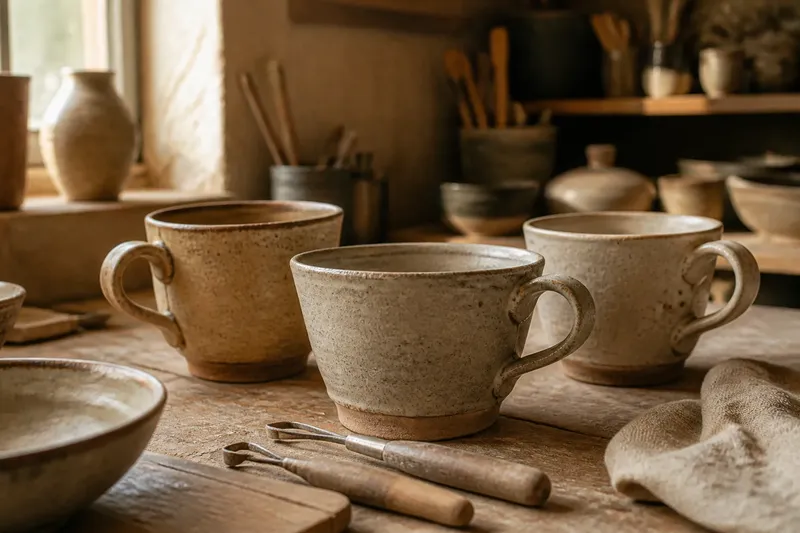
A shallow groove runs around the rim of a stoneware bowl, and the glaze gathers more thickly at one side. Those details are easy to notice when the bowl is held near a window. Handmade objects show the marks of their making in just this way: material and surface can preserve hints of actions, though no single mark tells the whole story.
Looking closely is not the same as identifying a maker or dating an object. A ridge might come from a hand tool, a mould, later wear or a deliberate finish. The useful question is narrower: what does the object let us observe about how it was shaped, joined and finished?
What counts as a mark of making?
A mark of making is a visible or tactile feature that may be connected to an action in production. It can be a cut, impression, seam, brush track, change in thickness or repeated pattern. It may also be a choice that appears across several parts of one object, such as a consistent way of rounding corners.
Some traces are direct. A row of small indentations in clay may record pressure from a tool or fingers. Others are indirect: a slight bend in a wooden edge could reflect how a board was selected, joined or later exposed to moisture. A trace is a clue, not a complete account of its cause.
It helps to separate three things: what is visible, what action might have produced it, and what that action could mean. “The rim is uneven” is an observation. “It was turned by hand” is an interpretation. “It was made by a particular person in a particular workshop” is a further claim, which needs more evidence than the rim alone.
How does the material shape the traces?
Material sets conditions for what can be done and what remains visible. Wet clay can be pinched, scraped and pressed before firing. Once fired, it holds a different surface; glaze may soften edges or fill fine cuts. Wood grain can guide a carving tool, while knots and changes in density may redirect it. Metal can carry hammer impressions, though later polishing may reduce their clarity.
These differences matter because a mark should be read in relation to its material. A rough patch on a woven basket may come from a change in fibre or tension. On a painted surface, a similar-looking patch might instead be a repair, a thick application or flaking. The same visual effect can have distinct causes.
Pay attention to transitions. Look where one material meets another, where a surface changes from rough to smooth, or where a cut ends. These areas often make a sequence easier to imagine: shaping may have come before joining, and finishing after both. But an object’s present condition can blur that sequence. Handling, cleaning, storage and repair all leave their own effects.
What can tool marks tell you?
Tool marks can suggest the kind of contact that shaped a surface, but they rarely identify a tool with certainty on their own. Parallel grooves might result from a comb, a toothed blade or repeated scoring with another implement. A curved cut may be consistent with a particular motion, yet the angle, pressure and material all affect its appearance.
Notice repetition and variation together. Repeated marks of similar spacing may indicate a regular action or a tool used in a controlled way. Small differences in depth or direction may show changes in pressure, material resistance or the position of the object. Neither pattern automatically proves that a person worked unaided; tools, templates and machines can all produce traces that look individual.
Lighting can help reveal shallow relief. Turn an object gently so light falls across rather than directly onto the surface, and look without rubbing or scraping it. For fragile, valuable or unfamiliar objects, avoid handling the surface and seek advice from a conservator or relevant specialist. Observation should not put the trace at risk.
Why do repeated workshop choices matter?
A single feature is often ambiguous. A cluster of related features can offer a more useful picture. Across a group of bowls, for instance, similar foot shapes, glaze boundaries and rim treatments may point to shared habits of production. The evidence is stronger when the details recur in a coherent way, rather than when one conspicuous irregularity is treated as a signature.
Repeated choices can be practical as well as expressive. A workshop may favour a certain handle shape because it is comfortable to form, or leave a joint visible because covering it would take extra work. A shared finish may reflect available materials, local practice, a customer’s preference or an individual maker’s taste. The object usually cannot tell us which motive mattered most without supporting context.
Imagine you are looking at three handmade cups from an unknown collection. Each has a slightly raised seam beneath the handle, while their rims vary. You might reasonably observe that the handle joins were finished in a similar manner. You could suggest a shared technique or production setting, but should not claim that one person made all three unless other evidence supports that reading.
Can an irregularity prove an object is handmade or old?
No. Irregularity alone does not prove either handmade production or age. Moulds, jigs and powered tools can leave variation; hand processes can produce strikingly uniform results. Damage and repair can also make a regular manufactured surface look uneven.
Age is especially difficult to infer from appearance alone. A worn edge may result from long use, rough handling, deliberate distressing or later abrasion. A darkened surface could reflect use, residue, a coating or an intervention. The feature needs to be considered alongside the object’s material, construction, condition and documented history.
For objects with financial, cultural or family significance, be careful about turning visual impressions into claims of provenance. A specialist may assess construction and condition alongside records or comparable objects. If those sources are absent, it is fairer to describe what can be seen and keep the interpretation open.
How should you describe a mark without overclaiming?
Start with plain, observable language. Record where the feature sits, what it looks or feels like from a safe distance, and whether it recurs elsewhere. Then offer a cautious possibility, making clear that it is an interpretation rather than a fact.
- Describe its location: say “a narrow groove on the underside” rather than “a maker’s groove”.
- Note its shape: record whether it is straight, curved, repeated, interrupted or irregular.
- Compare nearby areas: see whether the same feature appears at joints, edges or matching parts.
- Keep condition separate: distinguish a possible production trace from a scratch, chip, stain or repair.
- Use measured language: write “may be consistent with scraping” instead of declaring a specific tool or maker.
This kind of description is useful because another reader can check it against the object. It is like describing a folded map: the creases show how it has been handled, but they do not identify who carried it or where it travelled.
What questions help when looking closely?
How can I tell a tool mark from damage?
Look at whether the mark fits the object’s construction and repeats in a purposeful pattern. A scratch that cuts across finished surfaces may be later damage, while a repeated groove near a joint may relate to making, though neither clue settles the matter by itself.
Do handmade objects always have uneven surfaces?
No. Skilled makers can produce very regular forms, and tools or templates can help them do so. Handmade describes a mode of production, not a required look.
Can one mark identify a particular maker?
Usually not. A mark may be suggestive when it appears with other consistent features and reliable records, but isolated resemblance is weak evidence. Describe the feature before assigning it to a person.
Should I clean an object to see its marks more clearly?
Not without knowing what the surface can tolerate. Cleaning can remove residues, coatings or fragile finishes that are part of the object’s history. For a valuable or delicate piece, ask a conservator before attempting treatment.
When does close looking become a useful reading?
Close looking becomes useful when it keeps observation and interpretation in view at the same time. A seam, groove or uneven edge can prompt questions about sequence, material and shared practice; it cannot, by itself, settle identity or age. The strongest account is often modest: it names the trace, offers a plausible explanation and leaves room for alternatives.
That modesty does not make the object less revealing. It lets its surface remain evidence rather than turning it into a story too quickly. When you look at handmade objects, follow repeated choices as carefully as unusual marks, and let the material set the limits of what you can say.