The Myth That a Family Custom Has Always Been the Same
Family customs change over time as people adapt routines and retell their origins. Learn how to honour a tradition without mistaking memory for an unbroken rule.
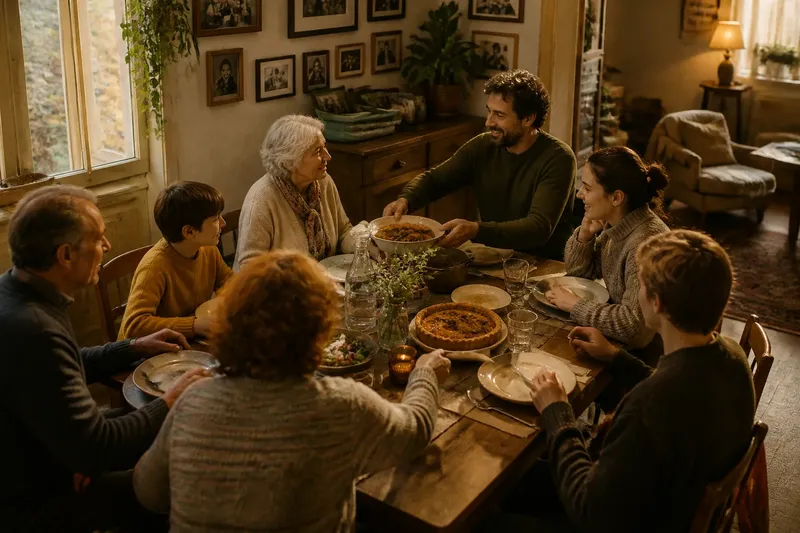
At a family lunch, someone reaches for the serving spoon before the eldest guest has sat down. A relative laughs: “We never used to do that.” Family customs change over time, often through just such small moments: a new household, a changed schedule, a different person at the table. The habit may still feel familiar, but familiarity is not proof that it has always been the same.
A custom is not a fixed object stored intact between generations. It is a shared practice that people repeat and interpret. The repetition gives it weight; the choices made around it give it shape. When a family tells its story as if the custom has never changed, that account can offer belonging, but it can also hide the very adaptation that kept the practice alive.
Why does a custom feel unchanged?
Rituals tend to preserve their recognisable outline. A meal may still happen at the same gathering, even as the menu, location and guest list shift. A birthday song may remain, while the person who leads it changes. Because people recognise the occasion, they may overlook the adjustments that make it possible.
Memory also favours a clean story. “We have always gathered on this day” is easier to repeat than “We gathered on the nearest free evening after someone’s shift changed.” The shorter account can express affection and continuity, not deliberate deception. But repeated often enough, it can turn a recent choice into an imagined rule.
Children learn customs by watching what adults do, not by consulting a record of earlier versions. They may inherit a gesture without knowing why it began. Later, they pass on what they remember, and their own version becomes part of the family’s memory. A custom can therefore feel ancient to those practising it even when its present form is comparatively recent.
Should you preserve the wording or the purpose?
Families often lean towards one of two approaches. One tries to preserve the visible form: the same dish, order of events, place or phrase. The other treats the purpose as more important and lets the form change. Neither is automatically more respectful. The choice depends on what people value and what the custom asks of them.
Form-centred preservation may suit a practice whose details carry particular meaning. Perhaps a relative’s handwritten recipe is read aloud before a meal, or each person contributes a familiar dish. Keeping those features can help people feel connected to someone absent. Yet a strict demand for exact replication can make participation difficult when ingredients, time, health or household circumstances have changed.
Purpose-centred adaptation may suit a custom built around welcoming people, remembering someone or sharing responsibility. The family might keep that intention while changing the location, timing or roles. Its risk is that the purpose can become so broad that no one knows what to do. A custom needs some recognisable action, not only a warm explanation.
Say a family has always, as its members tell it, made a particular pie for a winter gathering. Imagine the person who usually bakes it moves away, and another relative proposes bringing a different dish while everyone reads a line from the old recipe card. The expected observable result is a gathering that keeps a visible link to the recipe and the shared meal, without requiring the absent baker to reproduce the old arrangement. That version does not prove what earlier generations did; it shows how the family can choose what to carry forward now.
How can a family tell what it wants to keep?
A useful conversation begins with the practice as people actually remember it, rather than an argument over who has the most accurate version. Ask what happens, who takes part, and which details feel meaningful. Then ask what has changed and whether those changes have made the custom easier, harder or simply different to share.
- Name the action. Describe what people do, rather than relying on a broad label such as “our holiday tradition”.
- Separate remembered detail from established rule. Ask whether a feature was required, or whether someone simply chose it at the time.
- Ask who can take part. Notice whether the current form excludes relatives because of distance, time, ability or changing household arrangements.
- Identify the meaning people attach to it. Different relatives may value the same practice for different reasons.
- Choose one detail to retain and one to reconsider. A small, explicit choice is easier to discuss than a demand to preserve everything.
- Leave room for another version. A family can name its current practice without declaring it the final or only legitimate one.
This is not a test of whether a custom is “authentic”. It is a way to make decisions visible. Where one person’s account conflicts with another’s, both can be treated as memories rather than as a verdict on who belongs. A note in a family album or a conversation recorded with consent can preserve differing recollections without forcing them into a single origin story.
Which approach suits your family?
Does keeping the exact form matter most?
Choose close preservation when particular words, objects or actions carry a meaning relatives want to maintain. Agree on which details matter and avoid turning every incidental feature into a test of loyalty.
Is participation more important than the old arrangement?
Choose adaptation when the custom’s purpose matters more than its setting or sequence. Keep a clear, recognisable action so the practice remains something people can do together.
Can the family hold more than one version?
Allow parallel versions when relatives remember the custom differently or live with distinct needs. Naming each version openly can preserve connection without asking one person’s memory to erase another’s.
How should you decide between them?
Ask which features people would miss, which create unnecessary strain, and what the practice is meant to make possible. Then choose a form the people involved can explain and take part in, while leaving the choice open to revisit.
What does continuity look like after change?
Continuity need not mean sameness. A family may keep a meal but shift its day, keep a greeting but change who says it, or replace an old role with a shared one. These are not necessarily losses. They can be signs that people are still taking responsibility for the custom rather than treating it as an instruction left by someone else.
It can help to speak precisely: “This is how we do it now,” rather than “This is how we have always done it.” The first phrase honours the current practice without claiming more history than anyone can recall. It also gives younger relatives permission to ask how earlier versions differed.
Family customs change over time through choices that may seem too small to record: who brings the food, which story gets told, or whose needs shape the gathering. A useful inheritance is not a claim that nothing changed. It is a shared understanding of what the custom means now, alongside enough openness for the next generation to make its own considered choices.